
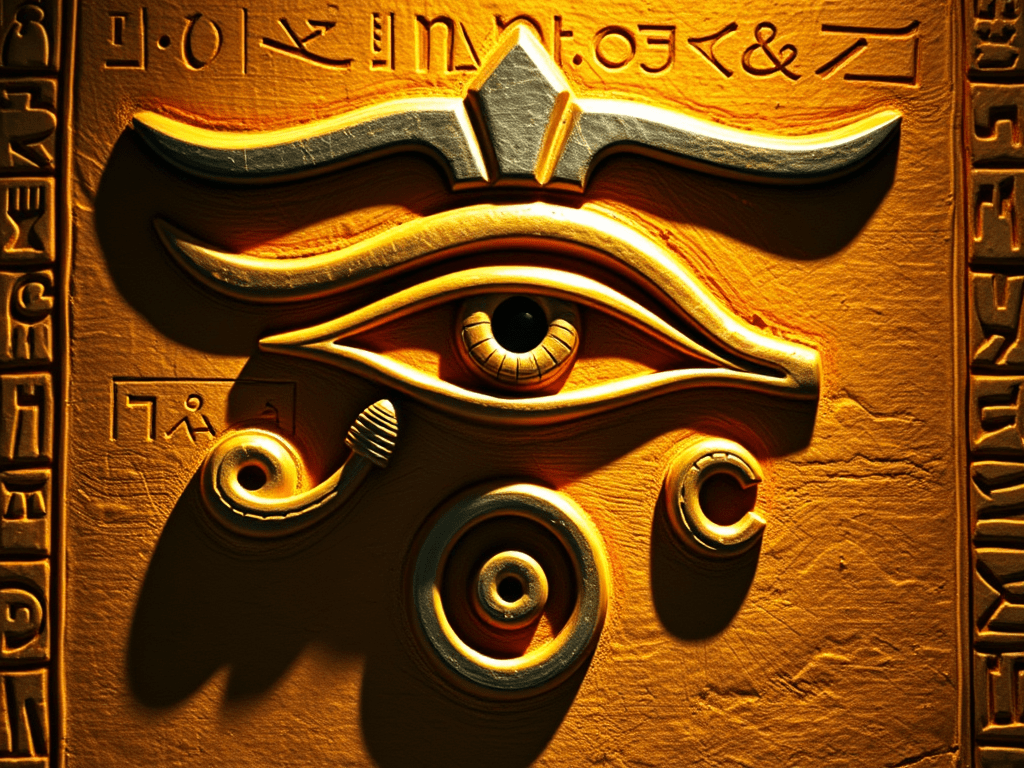
The Eye of Ra, also known as the Udjat Eye or Wedjat Eye, is one of the most recognizable symbols from ancient Egypt. More than just a striking image, it held deep religious and cultural significance, representing royal power, protection, and good health. This post will explore the rich history, mythology, and modern interpretations of this powerful symbol.
What is the Eye of Ra?
The Eye of Ra is a stylized representation of a human eye, often depicted with falcon markings (a reference to the falcon-headed god Horus) and a spiral beneath the eye. It’s crucial to distinguish it from the Eye of Horus, which, while similar, has distinct mythological associations. The Eye of Ra is typically associated with the sun god Ra, representing his all-seeing gaze and destructive power, while the Eye of Horus symbolizes healing, restoration, and protection.
Mythological Origins
The Eye of Ra has several mythological connections:
Ra’s Wrath: In one myth, Ra sends his Eye (personified as a lioness goddess like Sekhmet, Bastet, or Hathor) to punish humanity for their disobedience. This story highlights the Eye’s association with divine retribution and fierce power. The story often concludes with Ra recalling his Eye, sometimes through trickery (like dyeing beer red to resemble blood, which the Eye drinks, becoming intoxicated and docile), emphasizing his control over even his own power.
The Distant Goddess: Another myth tells of the Eye of Ra wandering far from Ra, causing chaos and destruction. Thoth, the god of wisdom, is often sent to retrieve her, bringing her back to Ra and restoring order. This myth symbolizes the cyclical nature of cosmic order and the importance of balance.
Symbolism and Meaning
Royal Authority: The Eye of Ra was a symbol of royal power and legitimacy, often associated with the pharaoh’s divine right to rule.
Protection and Healing: It was believed to offer protection against evil and illness, and was frequently used in amulets and protective spells.
Solar Power: As the Eye of the sun god, it represented solar energy, light, and cosmic order.
Destructive Force: The Eye also symbolized Ra’s destructive power and wrath, capable of inflicting punishment on those who defied him.
Use in Ancient Egypt
Amulets and Jewelry: Eye of Ra amulets were commonly worn for protection and good health.
Funerary Texts and Art: The Eye appears in funerary texts like the Book of the Dead and on sarcophagi, believed to protect the deceased in the afterlife.
Temple Decoration: The Eye of Ra was often incorporated into temple architecture and decoration, symbolizing the god’s presence and power.
Medicine: The Eye of Horus (often confused with the Eye of Ra) was used in ancient Egyptian medicine as a symbol for fractions, representing the different parts of the eye and their associated senses.
The Eye of Ra Today
While the ancient Egyptian religion is no longer practiced, the Eye of Ra continues to hold cultural significance.
Modern Symbolism: It is often used in jewelry, tattoos, and other forms of art, representing protection, power, and connection to ancient Egyptian heritage.
Occult and New Age Practices: The Eye of Ra has also been adopted by some occult and New Age groups, who associate it with various spiritual and esoteric meanings.
Pop Culture: The symbol appears in movies, books, and video games, often associated with ancient Egyptian themes and mythology.
Distinguishing the Eye of Ra from the Eye of Horus
It is essential to distinguish between the Eye of Ra and the Eye of Horus. While similar in appearance, they have different mythological associations. The Eye of Ra is associated with the sun god Ra and his destructive power, while the Eye of Horus is linked to the god Horus, healing, and restoration. The Eye of Horus is usually mirrored, with both a right and left eye representation. The Eye of Ra is usually depicted as a right eye.
Some Interesting Facts
Personification as a Goddess: The Eye of Ra was not just a symbol; it was often personified as a powerful goddess, most commonly Sekhmet (the lioness goddess of war and healing), but also sometimes Bastet (the cat goddess of protection and fertility), Hathor (the cow goddess of love and motherhood), or other fierce deities. This highlights the Eye’s active and potent nature.
Connection to the Uraeus: The Uraeus, the rearing cobra often seen on the pharaoh’s crown, is closely associated with the Eye of Ra. The Uraeus represented royal authority and protection, and its fiery venom was seen as an extension of the Eye’s destructive power.
The Myth of the Distant Goddess and its Variations: The myth of the Eye of Ra wandering away from Ra has several variations. In some versions, the Eye goes willingly, while in others, it’s sent on a mission. The reasons for its return also vary, sometimes involving persuasion, trickery, or even force. These different versions offer insights into the complex relationship between Ra and his Eye.
The Eye’s Role in Creation Myths: In some creation myths, the Eye of Ra plays a crucial role in the emergence of the world. It is sometimes said that the tears of the Eye, when it wept upon its return to Ra, turned into the first humans.
Association with the Sun’s Journey: The Eye of Ra was sometimes linked to the daily journey of the sun across the sky. It was believed that the Eye traveled across the sky with Ra during the day and then journeyed through the underworld at night, battling chaos and ensuring the sun’s rebirth each morning.
Use in Hieroglyphics: The Eye of Ra was a common hieroglyphic symbol, used not only to represent the Eye itself but also to convey concepts related to sight, light, and protection.
Confusion with the Eye of Horus: The similarities between the Eye of Ra and the Eye of Horus have led to much confusion and conflation of the two symbols. While they share some symbolic overlap (protection, royal power), their mythological associations are distinct. Emphasizing this difference is crucial for clarity.
Mathematical Significance (related to the Eye of Horus, often mistakenly applied to the Eye of Ra): The Eye of Horus was used to represent fractions in ancient Egyptian mathematics. Each part of the eye symbolized a different fraction of a hekat (a unit of volume, usually grain). This mathematical aspect is often mistakenly attributed to the Eye of Ra, emphasizing the need for clear differentiation.
Conclusion
The Eye of Ra remains a powerful and enduring symbol from ancient Egypt, representing royal authority, protection, and the multifaceted nature of divine power. Its continued presence in modern culture demonstrates the lasting impact of ancient Egyptian beliefs and symbolism.
 Random Habitant
Leave a comment