
For millennia, humanity has been driven to create, to build, to leave a mark on the world. From towering structures to breathtaking works of art, these creations have inspired awe and wonder across generations. The ancient Greeks first compiled a list of “must-see” wonders, a catalog of human ingenuity that has evolved over time. Today, we’re taking a whirlwind tour of the original Seven Wonders of the Ancient World, uncovering fascinating facts and celebrating the sheer brilliance of our ancestors.
1. The Great Pyramid of Giza: Still Standing Tall (and Full of Secrets)
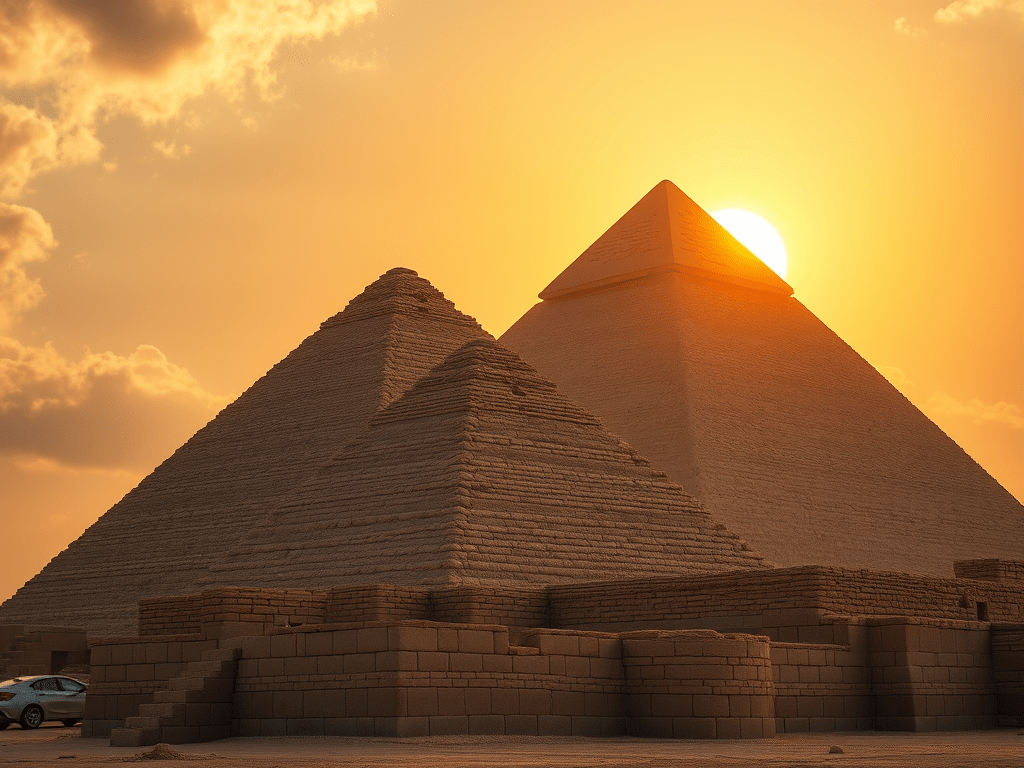
Let’s start with the only wonder still standing: the Great Pyramid of Giza. Built as a tomb for Pharaoh Khufu around 2560 BC, it remained the tallest man-made structure for over 3,800 years!
Fun Fact: It’s estimated that the pyramid is made of approximately 2.3 million stone blocks, each weighing an average of 2.5 tons. How they were moved and placed with such precision remains a subject of debate and fascination. Some theories suggest ramps, levers, and even water-powered lifts were used.
Intriguing Detail: Originally, the pyramid was covered in a casing of polished white limestone, making it gleam brilliantly in the sun. Sadly, most of this casing was later repurposed for other building projects.
2. The Hanging Gardens of Babylon: A Botanical Mystery
Described as a remarkable feat of engineering with an ascending series of tiered gardens, the Hanging Gardens of Babylon are shrouded in mystery. There’s even debate about their actual location! Some scholars believe they were located in Nineveh, not Babylon.
Fun Fact: Legend has it that King Nebuchadnezzar II built the gardens for his homesick wife, Amytis, who missed the lush greenery of her homeland.
Intriguing Detail: The gardens were said to have been an oasis of vibrant plants and cascading waterfalls in the middle of a desert landscape, a testament to the ingenuity of ancient irrigation systems.
3. The Statue of Zeus at Olympia: A God Among Statues
This colossal gold and ivory statue of the king of the gods, sculpted by Phidias, resided in the Temple of Zeus in Olympia. Imagine a 40-foot-tall statue of a seated Zeus, adorned with intricate details and radiating power.
Fun Fact: The statue was so large that the geographer Strabo wrote that if Zeus were to stand up, he would “unroof” the temple.
Intriguing Detail: The statue was destroyed by fire in the 5th century AD, leaving only descriptions and archaeological evidence to imagine its grandeur.
4. The Temple of Artemis at Ephesus: A Grand Ode to a Goddess
Dedicated to the Greek goddess of the hunt, wilderness, wild animals, and the Moon, the Temple of Artemis at Ephesus was renowned for its impressive size and ornate decorations. It was rebuilt several times after being destroyed by floods and arson.
Fun Fact: Pliny the Elder described the temple as “a wonderful monument of Grecian magnificence,” admiring its numerous columns and exquisite sculptures.
Intriguing Detail: The temple was famously burned down by Herostratus in 356 BC, who sought fame at any cost. He achieved infamy instead, with a decree forbidding anyone from mentioning his name.
5. The Mausoleum at Halicarnassus: A Tomb Fit for a King (and Queen)
Built as a tomb for Mausolus, a satrap in the Persian Empire, and his wife Artemisia II, the Mausoleum at Halicarnassus was a lavish and imposing structure. It was so grand that it gave us the word “mausoleum.”
Fun Fact: The tomb was adorned with hundreds of sculptures created by some of the most renowned sculptors of the time.
Intriguing Detail: It stood for over 1,600 years before being damaged by earthquakes.
6. The Colossus of Rhodes: A Bronze Giant Guarding a Harbor
This massive bronze statue of the Greek sun god Helios stood guard over the harbor of Rhodes. It was one of the tallest statues of the ancient world, comparable in height to the Statue of Liberty.
Fun Fact: The statue was said to have stood with its legs straddling the harbor entrance, allowing ships to sail between them. This is likely a myth, as such a design would have been structurally unstable.
Intriguing Detail: The Colossus stood for only 56 years before being toppled by an earthquake. Its remains lay scattered on the harbor floor for centuries.
7. The Lighthouse of Alexandria: A Beacon of Light and Engineering
Built on the island of Pharos in Alexandria, this lighthouse guided ships into the busy port. It was one of the tallest man-made structures of its time and a marvel of engineering.
Fun Fact: The lighthouse used a system of mirrors to reflect sunlight during the day and a fire at night, making its light visible for up to 35 miles.
Intriguing Detail: It was one of the longest surviving ancient wonders, standing for over 1,600 years before being damaged by earthquakes.
These Seven Wonders represent the pinnacle of ancient human achievement. They remind us of the incredible ingenuity, artistry, and ambition of our ancestors and continue to inspire awe and wonder to this day. Although most are now ruins or lost to time, their legacy lives on, fueling our curiosity and reminding us of the power of human creation.
 Random Habitant
Leave a comment